


St. Patrick was born to an aristocratic family in Britain in the fourth century. While he was a young man, Patrick was captured by Irish raiders and taken to Ireland where he was enslaved for six years. Due to this enslavement, Patrick never learned to read and is known as having a poor rhetoric because he was never taught the rhetoric of Britain. Patrick, however, learned a different type of rhetoric that allowed him to return to Ireland as an evangelist.
Patrick’s story is inspiring to me as a Christian. First, instead of resenting God and walking away from him because he was enslaved, Patrick used his knowledge of how the Irish thought and learned as a means of bringing them Gospel. When Patrick was able to return to Britain after six years in slavery, he became a bishop for the Roman Catholic Church and was called by God back to Ireland. A second way that Patrick inspires me is that God was able to use him to evangelize an entire barbarian country without a formal education! Because of being enslaved at the age of 15, Patrick did not receive the formal education he would have due to his family’s status in society. We can know based on Patrick’s life that God is able to use anyone at any academic level to spread his Gospel to those who haven’t heard. Finally, Patrick inspires me because he answered God’s calling in his life to be an evangelist to Ireland. When his critics were asked why Patrick returned to Ireland, they replied “He was compelled by God and called by the need of Irish.” If Patrick had not listened to God’s call for his return to Ireland, many Anglo-Americans would have a different life than the one they have today.

Although St. Patrick lived 1600 years ago as a contemporary of St. Augustine, his life and works still have an impact on not only Irish culture but also on the entirety of Christianity. So when you pull out your green this year and watch the parades (or pinch people for not wearing green), remember this incredible story about a man who followed God to a barbarian land and evangelized an entire country. To find out more about St. Patrick, his life and writings, check out the articles “St. Patrick in Fact and Fiction” by A. Haire Forster and “’Ego Patricius, peccator rusticissimus’: The Rhetoric of St. Patrick of Ireland” by Paul Lynch. You can search for these articles on Ebscohost and also the various books in the Library about St. Patrick.
~Jenny Dunning

And to think that just a few years ago, our library had very little to offer in the aesthetic realm. Our school has changed a lot. It's constantly ebbing and flowing, out with the old, in with the new. Soon, students will register for classes next semester, finish the semester strong, leave for the summer, and come back again in the fall. I know this next fall will be different. I know for sure that there will be new students who will contribute to a new PBU community culture. I know some of my favorite professors will be gone, and there will be new professors to fall in love with. Yet, loss is still a hard thing to deal with. Several of our students have been personally hit with this emotional tear, speechless, confused, angry, numb. Dr. Hirt, dean of the Bible department, has been struggling with cancer since last year. We've just been informed that Lisa Weidman, Director of Communications and Marketing and a key catalyst for the appearance of fine arts on campus, has a rare form of cancer. Unlike Dr. Hsu's death, theirs will be expected. We will have a little bit longer to celebrate our last times with them,
stories ebbing and flowing.
I wonder what stories Lisa intended to share with each piece of art she contributed to for our campus. I wonder what stories she will be sharing in heaven, stories that God has embedded on her heart, full of color and wonder and so much beauty, full of ebbs and flows.
~Hanah Bae
Slow Down, Stop, Look, Observe… and Contemplate
0 comments Posted by The Masland Library Blog at 4:02 PM

~Emily Rush

Amidst the many other assignments due from other classes, research can be tedious, especially when it feels like there are no books on your subject; but trust me there are! When I initially did research for my section of the project I saw only 5 books that contained to my subject. I was nervous that I may not have enough information, but eventually found just the book I needed. The next day when I arrived at work there were over 60 books containing the subjects we needed for this project that needed to be re-shelved! Imagine my surprise when I had previously assumed there were only 5. Many times people, including myself, just don’t put in the right terms in the search bar to find what we are looking for; but don’t worry you are not alone! There are many student workers here who would love to help you and our lovely librarians Laura and Alice are amazing at finding just the source you need to make your project a breeze. So don’t hesitate to ask for help! We would love to give you a hand.
~Leia Brunette
Image: http://www.penn.museum/collections/object.php?irn=117842
~Rosalyn Forbes
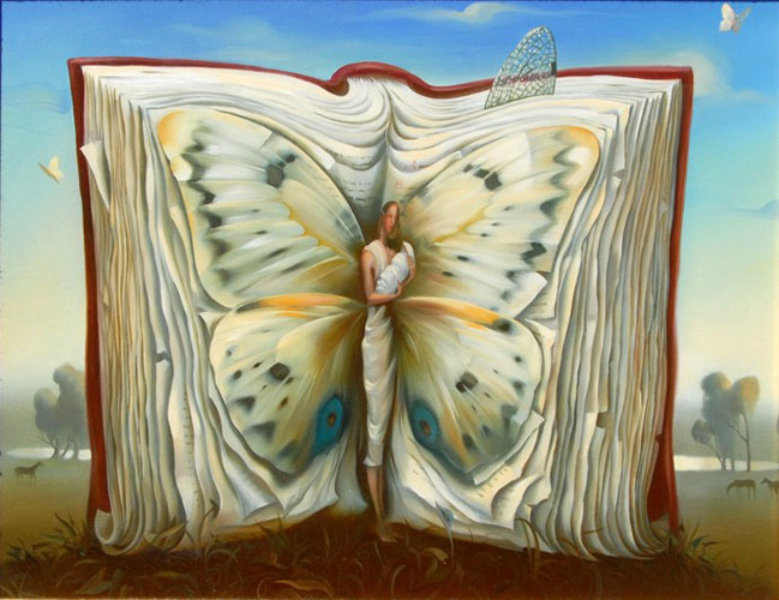
Kush, Vladimir. Book of Books. 2001. Private. Art Brokerage. Web. 30 Jan. 2012.


Makoto Fujimura leaves the viewer to imagine their own meaning out of his "Prodigal God" painting, but there are several little clues he gives to demonstrate this extraordinary grace. First of all, Fujimura used oyster shell pigments, the only opaque, transparent white pigment, to provide a vision of grace, which provides a stark contrast to the other side of the painting. And speaking of two sides, Fujimura informs his audience that splitting the picture is not recommended in the art world, but he intentionally employed this split to create a problem that humans cannot solve, which illustrates that grace does not equal doing stuff for God, but rather accepting His free gift.
I highly recommend reading Prodigal God (found at this call number in the library: BT378.P8 K25 2008) and meditating on its challenge to be a real prodigal who spends all they have to seek those who are lost in their sin. This is the challenge Fujimura is also trying to convey, and I believe it is crucial to embrace this grace and live it out.
~Allison Beyer

library for a few years now. It was one of the most beautiful messages I have heard and it seemed a lot of people found it to be really encouraging for where they are at and have been feeling. Although his artwork is most definitely fabulous, what touched me the most was the fact that he was able to make the message he shared this morning an art in and of itself.
He spoke on John 11. He focused on verse 11, pointing out that Jesus’ tears in this passage can aid our understanding of the arts and culture. He described three of the people present at the scene including Lazarus, Mary, and Martha. Each of these individuals had very different personalities, mannerisms, desires, thoughts etc. throughout the chapter. Because each of them was so different, the approach that Jesus Christ had to take to reach them individually had to be unique. Fuijimura reminded us that in our suffering and crises Jesus is the ultimate master of helping us uniquely in difficult situations. When life is filled with chaos, we need to be reminded that Jesus wept. He stated that a day will come when our sufferings will not be worth it anymore because we will be reclining with Jesus. Our reaction to this is to be that of love, prioritizing our lives, and truly living in Christ's freedom. Fujimura challenged us to face the world by creating and showing beauty, truth, and goodness. All of this should be done in confidence for God's glory.
Makoto Fujimura’s message displayed such reverence for the Lord, while also pointing out so many aspects of John 11 that I have never noticed. Take some time and check out the passage in light of Fujimura’s thoughts. Also, take some time and stop by the library to check out some of his artwork!
~Christa Joy Ciotta
Library Items by Makoto Fujimura
Makoto Fujimura's website
Image: Fujimura, Makoto. Aijo (Compassionate Love). Digital image. Makoto Fujimua. 1987. Web. 27 Oct. 2011.
Is art something that has stood the test of time and which displays an immense effort on the part of the artist to display creativity and ingenuity? Or can art be a picture of a paperclip with the word “AND” written below it? Faced with these questions in Lit and Arts class today, I started to ponder how art demonstrates societal beliefs.
The Greeks and Romans were fascinated by humanity, and their statues demonstrate it. The Byzantines were focused on Christ and their churches with mosaics and paintings of Christ at the apse demonstrate this focus. What does our post-modern art say about the era in which we live?
The magazines in the library were my starting point in helping me consider what the world believes is important. I noticed a focus on politics and pop culture. Two areas where the question, “what is reality?” is raised. Pick up a book about modern art and read about Marcel Duchamp’s Fountain or Bottle Rack. What is the standard for art? Who is to say whether these anti-art objects truly are works of creativity, masterpieces in their time?
I challenge you to question the world around you and test it within this framework. What are we saying by endorsing fabricated objects with artist’s names signed to them? Where is our trust and hope? What is art?
Marcel Duchamp's Fountain Jonathan Hardesty's Walter


~Allison Beyer
 Philadelphia Biblical University was privileged to host a display featuring one of the volumes of the Saint John’s Bible for a month. This display was simply lovely and reminded me just how influential the Bible has been to Western civilization and culture. Before I go into that let me tell you about the Bible. The Saint John’s Bible is a work that has spanned more than a decade. Saint John’s seminary in Minnesota houses a significant number of early pre-printing press manuscripts. When the president of the university and the director of the manuscript library had dinner together they conceived the idea that it would be a marvelous task to create a new manuscript using the old techniques used prior to the print press. It took a number of years to get the team and finances in place, but as of this year the 8 volumes housing the Bible (with Apocrypha) and a volume representing the artistic team and donors is now complete.
The manuscript at Saint John’s is printed on vellum which is made from animal skin, is translucent and is the traditional material that manuscripts were written on in the days before the printing press. They used minerals and gold leaf for their numerous illustrations found throughout the text. The process of constructing the original volume was completed in a scriptorium in Wales however because the volume would permanently reside at Saint John’s the Bible would reflect the flora and fauna of Minnesota. It would also reflect the more worldwide culture and technology that we found in science (DNA is pictured in the illustration reflecting Jesus’ ancestry).
Donald Jackson, the Queen’s official calligrapher, was in charge of designing the script that would grace the pages of manuscript. He was also in charge of the team who worked on the illustrations and final product. Over a year was spent designing the script that would be used, the illustrations, and the sequencing before anything could be placed on the vellum sheets. Once the script was finalized and the illustrations approved they began the laborious process of uniting script and illustrations. For the first time since the printing press the Bible would be handwritten from start to finish using the same methods used at scriptoriums in medieval and renaissance eras.
The Masland Library hosted a copy of the Gospels/Acts volume as well as a number of framed prints from August 26-September 23. The use of paintings and calligraphy is simply stunning even as a reproduction. The first page of each book had a whole page illustration, while similar is style each reflected the tone of the book. To see more of these pages you can view the Bible from start to finish at the following web address: http://www.saintjohnsbible.org/see/explore.htm.
What struck me most about this Bible wasn’t just that it was beautiful, but how the beauty of the illustrations reflects the beauty that God created. If you take a look at the Library’s art, Christianity, and culture section you will see that this section is growing and most of the growth has taken place within the last decade. The protestant church has moved away from the idea that art is separate from their faith and I think that is amazing and proper. Everything we do, everything we produce comes from who we are and the worldview we hold. Therefore as the Bible states we should be more than the world because our God is greater than the world; and after all God created the world for us in all its beauty and mystery. The Bible may not be in the Library anymore, but if you are interested in artistic expression you can still view and checkout books that may inspire you in your creative or spiritual journey. I would also point out that we currently are hosting an exhibit of Jonathan Hardesty’s work in the museum area of the Biblical Learning Center and will be hosting an evening talk/chat with Makoto Fujimura on October 26 starting at 7:00pm.
~Laura
Freeman, Michael. "Inscribing The Word, Photographs." Smithsonian 31.9 (2000): 78. Academic Search Premier. EBSCO. Print
Ola, Per, and Emily D'Aulaire. "Inscribing The Word." Smithsonian 31.9 (2000): 78. Academic Search Premier. EBSCO. Web. 28 Sept. 2011.


Dictionary.com defines art as “the quality, production, expression, or realm, according to aesthetic principles, of what is beautiful, appealing, or of more than ordinary significance” (Dictionary 1), but can all these terms truly define what art is? Does art have to be considered beautiful and have more than ordinary significance? Can we assume that art may be something that stimulates a large group of people’s emotions? If so, could we conclude that art is defined as something that is of more than ordinary significance due to its popularity? In other words, can something be considered out of the ordinary even if no want appreciates it?
I believe art can only be defined by an individual’s perspective. For example, I believe that Jackson Pollock’s “Untitled #3” is a work of art while other believes that it is just a bunch of paint splattered randomly on a canvas. In addition, it can also be seen that art can be considered something that stimulates our way of thinking. When I look at this painting, I think of a variety of things. For example, I think of the hardships of life. The splatters represent the random and sporadic hardships that an individual faces daily each day in life while the black base represents us as individuals trying to prosper through the hardships that constantly build if we attempt to avoid them. In other words, I believe that this painting represents what happens to those who run from their hardships. It becomes so much chaos that all of the small hardships of life have accumulated and transformed into one big issue that can only be resolved by gradually sorting through and resolving each individual hardship that created this monster of an issue.
In conclusion, I believe that our individual perspective of what is beautiful and what is of interest defines what art is. I also believe that art can also be an appreciation of something that we are unable to do. For example, some people are able to appreciate the fact that Muay Thai is not just a system of combat but an art. In conclusion, I believe that art is something that is able to define us as well as God about who we are.
~Dan Champa
RSS Feed


 Posts
All Comments
Posts
All Comments